

This post was written by Vincent Seguin, Bridgit’s Chief Technology Officer
Bridgit AI was an exciting launch for us last year, and we’ve been busy since that milestone. The world of AI changes by the day, and our team has been hard at work on the next generation of Bridgit AI features. This post offers a sneak peek into what’s coming in the near future.
Evolving the structure
Our first version of Ask Bridgit worked, but it was a fairly monolithic approach to the problem – essentially a sophisticated chatbot. We quickly saw real-world usage trending in two directions: data questions, but also a lot of support questions, which we were initially unable to answer because Ask Bridgit only knew its own database as a data source. It became clear we needed an agent loop with intent-based routing.
So we set about revamping Ask Bridgit internally to introduce what we call “the Receptionist”: a layer that detects the intent behind a user’s query and dispatches it to the right agent. As part of this, we renamed the original Ask Bridgit to the Data Analyst Agent, which in turn let us introduce a second agent: the Customer Support Assistant, dedicated to the support questions Ask Bridgit couldn’t previously handle. The structure looks like this:

This is already running internally, and it’s a meaningful step forward – but it doesn’t yet solve our longer-term vision: getting to genuine agents that can help with real workforce planning tasks. And one question slowly but surely emerged: is Ask Bridgit a proper foundation we can build agents on?
Hackathon to the rescue
Sometimes the best thing to do is take a big step back and let the creative juices flow, which is exactly what a hackathon is built for. At the end of April, the entire team met in Montreal with a single goal: a hackathon dedicated entirely to agents. Our product team prepared a long list of agents Bridgit could offer, and over two days our teams built and experimented with different approaches and technologies. The experience was genuinely enlightening.
It also answered our question: Ask Bridgit can become our AI foundation—not just a platform feature—but it needs one more concept: skills (also known as workflows). One model emerged: one agent, many skills and workflows.


Adding skills
Take the objective of building a team for a new project. Technically, Ask Bridgit already has all the data required to do it. What it doesn’t have is the layer of logic to understand what a good team actually is—which parameters to look at, how to weigh them, how to capture each user’s preferences, and so on.
As it happens, Claude has introduced just the right vehicle for this: skills. So what if we reused that concept inside Ask Bridgit? That led us to a third agent in our internal suite: the Skill Agent, which works as follows.
Skills are described in Markdown files, loaded into Ask Bridgit through a skill registry. Each skill roughly defines:
- the type of question it should answer
- the data it requires (which can leverage the existing Data Analyst Agent)
- the workflow it performs
- the structure of the data it outputs
When a user asks a question that matches a skill, the Receptionist routes the intent to the Skill Agent, which reads and executes the appropriate skill.
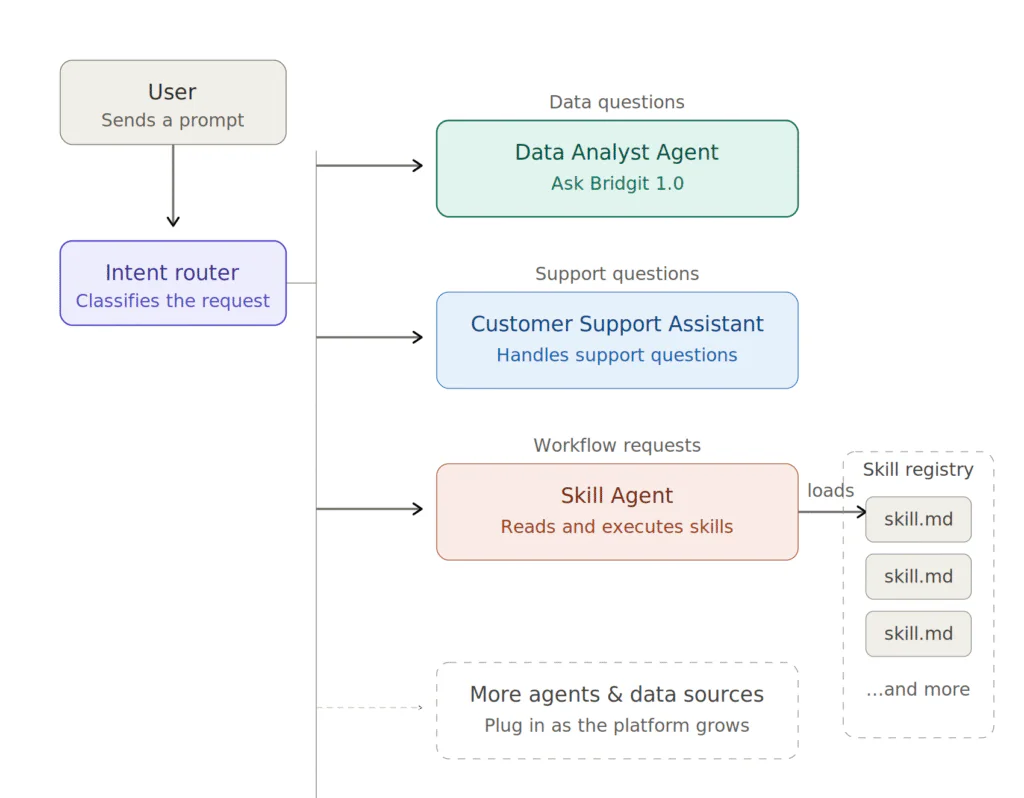
The beauty of this structure is how generic it is: adding a new workflow “simply” means adding a new skill. It also unlocks what we call dynamically generated UI – because each skill defines its own contract, we can map that contract in our frontend and generate the right components for each workflow on the fly.
This has been a real breakthrough for us, but we’re still in the territory of answering questions, albeit much more complex ones. In our team-building example, and in general, how do we get from answering to doing?
Leveraging our MCP
In parallel, we’ve been working on developing our MCP (Model Context Protocol). MCP is an open standard that lets AI assistants connect to external tools and data sources. The first version was read-only, but we’ve been working since then to enable writes. The advantage of routing writes through the MCP is that it already respects all of our validation, permission guards, and business rules – because it leverages our existing API internally.
To truly turn Ask Bridgit into an agentic “Do Bridgit”, we decided to dogfood our own MCP inside it. This is the architecture we’re building towards: adding a fourth agent, dedicated to performing actions suggested by the others. We see a world where any agent can emit a generic list of suggested actions, which Ask Bridgit re-injects into this fourth agent, which in turn calls our MCP to carry them out.
Put together, the picture starts to come into focus: the Receptionist understands what you’re asking, the Data Analyst and Support Agents answer, the Skill Agent runs the domain workflows, and this fourth agent turns their suggestions into real actions through our MCP—safely, within your existing permissions. Each piece is built independently, but they compose into something larger than the sum of its parts: a foundation where adding a new capability is a matter of adding a skill, not rebuilding from scratch every time.
And what about quality?
That’s a lot of building in a short amount of time. But at the end of the day, what matters most to customers is the quality of our agents. Back to the team-building example: how do we ensure we actually suggest a good team?
The missing piece tying all of this together is evals – the agent harness – which has been a hot topic across the AI world. We’re actively building our internal harness, which will let us aggressively monitor the quality of Bridgit AI across response accuracy, latency, and limitations. More to come on that specific piece in an upcoming dedicated blog post.
What’s coming next
I won’t pretend to claim that we’re finished, some of this is still in development, and the most interesting parts are the ones we’re not quite ready to share publicly. But the foundation is real: intent routing is live in production, skills are already executing in our development environment, and our MCP is on its way from read to write. The hard architectural questions are answered. What’s left is building on it.
Stay tuned. Agents are coming, and this time “coming” means we’re standing on something solid rather than sketching on a whiteboard. It’s a genuinely exciting time to be a Bridgit customer!