
Every experienced project manager has watched a job go sideways. The schedule looked solid in preconstruction. The team seemed capable. Then somewhere around month three, RFIs started stacking up, a key subcontractor fell behind, and suddenly the project that was tracking to plan became a daily firefight.
Table of Contents
The difference between projects that recover and projects that spiral rarely comes down to luck. It comes down to how the team planned, who they staffed, how they communicated, and whether they caught problems early enough to do something about them.
This guide covers how to manage a construction project the way experienced operators actually do it. Not with generic advice about “being organized,” but with the specific practices that separate well-run jobs from chaotic ones.
Why Construction Projects Miss Their Targets
Before talking about what to do, it helps to understand what actually goes wrong. Failed projects tend to cluster around four problem areas: front-end planning, execution discipline, external shocks, and commercial behavior.
Front-end failures include incomplete designs that generate RFIs during construction, unrealistic schedules that ignore productivity data and permit timelines, and budgets that skip escalation clauses and contingency. Value engineering decisions made late (after procurement has started) create cascading problems that touch every downstream trade.
Execution failures show up as poor short-interval planning, where field teams work from a master Gantt chart that doesn’t drive daily commitments. Sequencing clashes between trades, out-of-sequence work, and logistics problems (materials delivered before the site is ready, or delivered late) compound quickly. Progress tracking that relies on lagging indicators (monthly pay apps instead of weekly variance analysis) means slippage gets spotted too late.
External shocks have become more visible since 2020. Long-lead items like switchgear, air handlers, and curtainwall systems can derail schedules when procurement wasn’t aggressive enough. Permitting timelines, utility coordination, and inspection cycles get underestimated. Weather events and site disruptions happen without contingency plans for resequencing.
Commercial and behavioral failures may cause the most damage. Contracts with gray areas on change entitlement create disputes that stall decisions. Weak documentation means legitimate impacts can’t be demonstrated. When owner-GC or GC-sub relationships turn adversarial, people protect positions instead of solving problems.
The projects that recover share common traits: they surface problems early, act decisively on the critical path, and maintain unified decision-making. The projects that spiral deny problems, fragment authority across competing priorities, and let claims behavior replace collaboration.
Understanding these patterns changes how you approach every other aspect of managing construction projects.
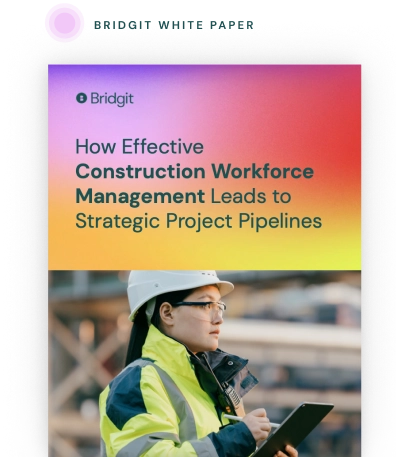
Use your workforce data to create a competitive advantage
Download our white paper to see how effective workforce planning can help stay ahead of labor demands and create a strategic project pipeline.
How to Plan a Construction Project That Can Actually Be Built
Planning failures account for a disproportionate share of troubled projects. The goal isn’t a plan that looks good in a presentation. It’s a plan that survives contact with reality.
Start with scope stability. Design coordination needs to happen before procurement and field start, not during. Every RFI generated during construction represents a planning gap that now costs more to fix. If the design isn’t ready, the schedule isn’t ready either.
Build realistic baselines. Durations should reflect actual productivity data, not optimistic estimates. Account for weather windows, permit review cycles, and known market constraints. If specialty trades are stretched thin regionally, your schedule needs to reflect their real availability, not their promises.
Map risks explicitly. Create a risk register that covers permits, utilities, site access, supply chain, and key subcontractors. Assign an owner to each risk. Agree on playbooks for common scenarios before they happen: what triggers schedule recovery, who has authority to approve acceleration, how changes get priced and processed.
Plan for what you don’t know. Contingency isn’t padding; it’s acknowledgment that construction doesn’t go exactly as planned. Build float into the schedule where you can. Size contingency to the actual risk profile of the project, not to an arbitrary percentage.
The best plans include a clear view of dependencies. A Gantt chart showing which activities block which others lets you see the ripple effects when something slips. The Bridgit Forecasting Dashboard supports this kind of forward-looking analysis, connecting your workforce availability to your project pipeline so you can see problems before they arrive.
Building the Right Project Team
Staffing decisions shape outcomes more than most managers realize. The difference between a PM who’s right for this project and one who’s merely available can be the difference between a successful job and a recovery situation.
Staff by suitability, not availability. High-performing contractors treat staffing like portfolio risk management. They match project complexity, client context, and risk profile to the proven strengths of their people. “Who’s free” is a question, but it shouldn’t be the answer.
For each project, consider:
- Complexity factors: new vs. repeat client, greenfield vs. renovation, familiar jurisdiction vs. new territory, technical difficulty
- Risk profile: margin importance, liquidated damages exposure, design completeness, subcontractor market strength
- Client fit: sophisticated owner vs. first-timer, collaborative vs. adversarial environment, political sensitivity
- Delivery approach: self-perform scope, BIM coordination intensity, commissioning requirements
Then match those needs to the actual strengths of available PMs and superintendents, not just their titles or years of experience.
Pair leaders deliberately. PM-superintendent chemistry matters. A strong PM paired with a misaligned super often underperforms two good-not-great leaders who work well together. Consider prior working relationships, complementary styles (relational PM with detail-oriented super, or vice versa), and how they’ll handle conflict.
Protect capacity. Double-booking your strongest people across too many critical jobs leads to burnout, slow decisions, and poor oversight. Use a portfolio-level workload view and set explicit limits on concurrent major projects per leader.
Define roles clearly. Fuzzy handoffs between preconstruction and operations create confusion. Ambiguity about who owns schedule, buyout, change management, or client communication leads to gaps and duplicated effort. A simple responsibility chart reviewed at kickoff prevents most of these problems.
The 2025 State of Workforce Planning report found that 93% of construction leaders say labor shortages are impacting their operations, with 42% reporting reduced ability to take on new projects. Strategic staffing isn’t optional when the talent pool is this constrained.
Communication That Actually Works
Chaotic projects rely on ad-hoc conversations, unclear responsibilities, and poor documentation. Well-run projects use simple, consistent communication routines with clear owners for each information flow.
Establish a communication plan. Document who talks to whom about what, through which channels, at what cadence. This doesn’t need to be complicated: one page that defines the communication matrix, response time expectations, and escalation paths.
Set meeting rhythms that drive action:
- Daily huddle (10-15 minutes): Superintendent plus foremen and key subs onsite. Cover safety, site constraints, today’s work, critical handoffs, deliveries, inspections.
- Weekly subcontractor coordination (60 minutes): PM, superintendent, all major subs. Review the 2-3 week look-ahead against baseline. Surface conflicts on space, access, crane time, MEP stacking. Address RFIs blocking work. Track changes and T&M.
- Weekly internal review: PM, superintendent, PE, project engineer. Commitments from last week, submittal and RFI aging, risk register, forecast vs. budget and schedule.
- Weekly or bi-weekly owner touchpoint (30-60 minutes): Schedule status, decisions needed, change status, key risks.
- Monthly formal owner report: Milestone status, photos, financial summary, contingency usage, risks and mitigations.
Define response expectations. RFIs should have a standard turnaround (three business days is common, with one-day response for anything flagged as critical path). Submittal reviews might be ten business days. Whatever you choose, communicate it and track against it.
Designate single points of contact. The PM owns owner and design communication. The superintendent owns field crew and subcontractor communication. A specific coordinator manages RFIs, submittals, and meeting documentation. When multiple people give the owner or subs conflicting direction, the project suffers.
Document decisions. Meeting minutes should capture decisions, action items, owners, and due dates. Verbal field changes need to become written records (RFIs, CCDs, or change orders). When disputes arise later, contemporaneous documentation determines who has leverage.
The most damaging communication failures aren’t dramatic blowups. They’re slow RFI responses that create idle crews, version confusion that causes rework, and unclear expectations that surface as punch list disasters at turnover.
Execution and Course Correction
Good plans need adjustment. The question is whether you’re adjusting proactively or reacting to crises.
Use short-interval planning. The master schedule sets direction, but the 2-3 week look-ahead drives daily work. Pull planning sessions with trade foremen create realistic commitments. Track percent plan complete (PPC), the percentage of planned activities actually finished, as a measure of schedule reliability. When PPC drops below 80-85% for multiple weeks, the plan isn’t trustworthy.
Watch the critical path. Total float tells you how much schedule buffer remains. You might be hitting milestones while float on critical and near-critical paths erodes. That pattern predicts future delays. Understand which activities actually control your completion date and protect them.
Inspect before clients do. Quality control processes that catch issues before the owner’s inspection protect your reputation and your schedule. Rework is expensive in dollars and devastating to morale. Track first-pass inspection rates; high failure rates early predict punch list blowouts later.
Read contracts thoroughly. Standardized contracts from AIA or ConsensusDocs still contain provisions that matter when disputes arise. Review them before signing, raise questions about ambiguous items, and understand the notice requirements for changes and delays. The project team should know what triggers contractual obligations, not just the legal department.
Know when to escalate. Some problems should be handled at the field level. Others need PM attention. A few require executive intervention to cut through bottlenecks (design decisions stalled for weeks, commercial compromises needed with the owner, key subcontractor failures that require replacement). Define thresholds, such as days of delay or dollars of impact, that trigger escalation. Then use them.
Recover systematically. When projects fall behind, the instinct is to add overtime and push subs harder. This rarely works without resequencing. Effective recovery starts with identifying the actual root cause: which activities are on the critical path and why they’re underperforming. Then test options (resequencing, parallel work, additional crews, longer shifts, prefabrication, phased turnover). Quantify time-cost tradeoffs before committing resources. Get owner buy-in on recovery strategies so you’re not absorbing costs you shouldn’t own.
Technology That Actually Pays Off
“Keep up with the times” isn’t useful advice. Understanding which technology investments return value, and which are just overhead, helps you make better decisions.
What clients and trade partners now expect:
General contractors have standardized around core capabilities:
- Document and drawing management with version control, markup, and mobile access
- RFI, submittal, and change order tracking
- Budget and cost tracking with WIP snapshots
- Schedule integration (at minimum with MS Project or Smartsheet)
- Field reporting: daily logs, photos, time entry, safety checklists
- Subcontractor and owner portals with notifications and workflow approvals
- Cloud and mobile-first architecture with role-based permissions
If your tech stack lacks these capabilities, you’re operating at a disadvantage. Procore, Autodesk Construction Cloud, CMiC, and RedTeam all cover this ground. Smaller firms often use horizontal tools like Smartsheet or monday.com alongside construction-specific platforms.
What’s becoming differentiating:
Leading contractors are pulling ahead with capabilities that go beyond project administration:
- Integrated project-financial systems: Tight connection from field quantities and time to commitments to actuals to corporate ERP. Real-time margin visibility at project and portfolio level.
- BIM-centric workflows: Design-to-build continuity, clash detection before field conflicts, models linked to quantities and schedules for 4D/5D planning.
- Advanced analytics and AI: Schedule risk prediction, automated RFI routing, computer vision for progress measurement, productivity analysis across projects.
- Owner-grade reporting: Automated status reports from field systems, real-time dashboards showing change exposure and contingency usage.
Where ROI concentrates:
Technology investments pay off most clearly in four areas:
- Reducing rework through better document control and version management (crews working from current drawings make fewer mistakes)
- Improving labor productivity via mobile daily logs, time capture, and inspection checklists that cut admin time for field supervisors
- Enhancing schedule reliability through integrated look-ahead planning and AI tools that identify bottlenecks early
- Protecting margins through project-finance integration that shows cost variance before it becomes a monthly surprise
The worst technology investments are tools that add reporting burden without changing decisions, platforms that don’t integrate with your existing stack, and systems that require so much maintenance they become their own project.
Metrics That Catch Problems Early
What you measure shapes what you manage. The right metrics surface problems while there’s still time to act.
Financial health:
- Cost Performance Index (CPI): Earned value divided by actual cost. Below 1.0 means you’re over budget for the work completed.
- Budget variance: Actual vs. budget by phase and overall. Track forecast at completion against original budget.
- Margin tracking: Forecasted and actual margin vs. bid margin. Watch for erosion.
Schedule health:
- Schedule Performance Index (SPI): Earned value (time) divided by planned value. Below 1.0 means you’re behind schedule.
- Float on critical and near-critical paths: SPI might look acceptable while declining float predicts future delays.
- Look-ahead hit rate: Percentage of activities in the 2-3 week look-ahead completed as planned. Below 80-85% for multiple weeks signals unreliable planning.
Quality:
- First-pass inspection rate: Percentage of inspections passed on first attempt.
- Rework rate: Hours or cost spent on rework as percentage of total.
- Defect density: Defects per 1,000 square feet or per inspection cycle.
Safety:
- Total Recordable Incident Rate (TRIR) and Lost-Time Injury Frequency Rate (LTIFR)
- Near-miss reporting volume: Rising near-misses with weak corrective follow-through predict serious incidents.
Leading indicators to watch:
These metrics provide early warning before CPI, SPI, and margin reflect problems:
- Pending changes vs. remaining contingency: When unapproved change orders approach remaining contingency, margin is at risk, before changes are approved.
- Buyout variance: Packages bought over estimate early signal margin compression.
- RFI volume and age: Spikes in RFIs, especially on structure and MEP, predict coordination delays. Lengthening response times signal decision bottlenecks.
- Subcontractor productivity trends: Declining units per hour or crew output shows up weeks before CPI drops.
Review cadences:
- Weekly: CPI/SPI trends, look-ahead hit rate, RFI aging, pending changes, safety observations, sub performance
- Monthly: Forecast at completion vs. budget, margin trends, quality metrics, risk register review, top risks requiring executive attention
For a deeper look at tracking project performance, see the guide on construction KPIs.
Making It Work
Managing construction projects well requires judgment that develops over years. But judgment improves faster when it’s supported by good systems: realistic plans, the right teams, clear communication, and metrics that catch problems early.
The practices in this guide aren’t theoretical. They reflect how experienced operators think about their work, as a series of decisions about planning, people, communication, execution, technology, and measurement that compound over the life of a project.
The foundation of all of it is knowing your workforce: who’s available, what they’re good at, where they’ve succeeded before, and how they work together. That visibility is what Bridgit provides, a platform for workforce planning that connects your people to your projects and gives you the data to make better staffing decisions.
Request a demo to see how it works.
Frequently Asked Questions
What are the six key stages of effective construction project management?
The six key stages of effective construction project management are:
- Project initiation
- Planning
- Design
- Construction
- Monitoring and controlling
- Project closeout
What are the 7 steps to project planning success for project managers?
The 7 steps to project planning success are:
- Define the project scope
- Identify key stakeholders
- Develop a detailed project plan
- Create a project schedule
- Allocate resources
- Implement risk management strategies
- Establish a communication plan
What is the best methodology for construction project management?
The best methodology for construction project management is often the Critical Path Method (CPM), which helps in scheduling project activities, identifying the longest path of tasks, and ensuring timely project completion.
How to organize a construction project?
To organize a construction project, create a detailed project plan, develop a clear schedule, allocate resources efficiently, establish a communication plan, and use project management software to track progress and manage tasks.
How to control a construction project?
Control a construction project by setting clear milestones, monitoring progress regularly, maintaining open communication with stakeholders, using project management software, and implementing quality control measures to ensure standards are met.
What are the keys to a successful construction project?
Keys to a successful construction project include effective planning, clear communication, efficient resource management, strict adherence to safety protocols, and regular monitoring and controlling of project progress.
What are the 5 essential phases of construction project management?
The 5 essential phases of construction project management are:
- Initiation
- Planning
- Execution
- Monitoring and Controlling
- Closeout
What are the four main elements to the construction management process?
The four main elements to the construction management process are:
- Planning
- Scheduling
- Budgeting
- Quality Control
What are the five processes in initiating a construction project?
The five processes in initiating a construction project are:
- Defining project goals
- Conducting a feasibility study
- Assembling the project team
- Creating a project charter
- Identifying stakeholders
What is the life cycle of a construction project?
The life cycle of a construction project includes the following phases:
- Initiation
- Planning and design
- Execution (Construction)
- Monitoring and Controlling
- Closure and handover
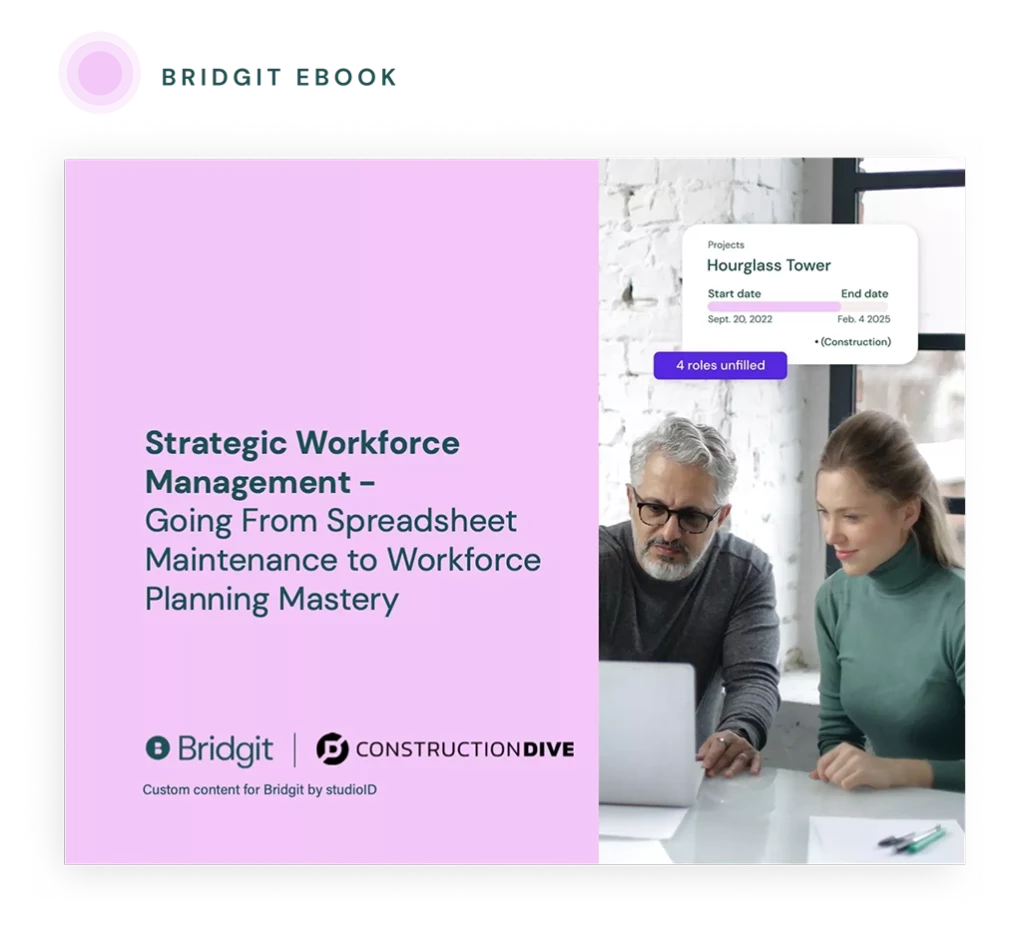
Looking to be more strategic with your people?
We partnered with Construction Dive to outline the steps any contractor can take to be more strategic with their workforce management.